Introduction
Chemical Reactions and Equations
Currently viewing: English · Tap the glowing switch to change language
Welcome to the Chapter
Hello, students! Today we are going to begin the first chapter of Class 10 Science, titled Chemical Reactions and Equations.
Many changes take place around us every day. Milk turns into curd, iron gets rusted, food is cooked, and substances burn. Have you ever wondered what causes these changes?
Many of these changes occur because of chemical reactions. In this chapter, we will learn what a chemical reaction is, how it can be identified, and how it can be represented with the help of chemical equations. Let us begin with some interesting events from our surroundings.
अध्याय का परिचय
नमस्कार विद्यार्थियों! आज हम कक्षा 10 विज्ञान का पहला अध्याय शुरू करने जा रहे हैं, जिसका नाम रासायनिक अभिक्रियाएँ एवं समीकरण (Chemical Reactions and Equations) है।
हमारे आसपास हर दिन अनेक बदलाव होते हैं। दूध से दही बनना, लोहे पर जंग लगना, भोजन पकना और किसी पदार्थ का जलना—ये सभी हमारे दैनिक जीवन में होने वाली घटनाएँ हैं। लेकिन क्या आपने कभी सोचा है कि इन बदलावों के पीछे क्या कारण है?
इनमें से कई बदलाव रासायनिक अभिक्रियाओं (Chemical Reactions) के कारण होते हैं। इस अध्याय में हम जानेंगे कि रासायनिक अभिक्रिया क्या होती है, इसे कैसे पहचाना जाता है और रासायनिक समीकरणों की सहायता से इसे कैसे दर्शाया जाता है। तो चलिए, अपने आसपास होने वाली कुछ रोचक घटनाओं से शुरुआत करते हैं।
Milk Turning into Curd
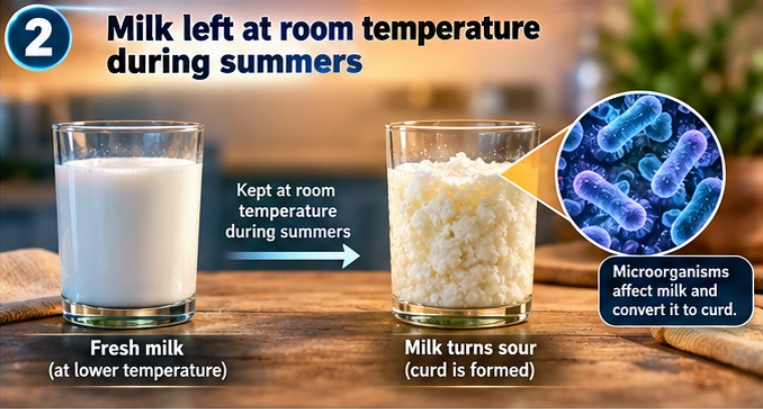
In this picture, you can see fresh milk and milk that has turned sour and curdled after some time.
During warm weather, when milk is left at room temperature, certain bacteria present in it can multiply rapidly. These bacteria convert a sugar called lactose into lactic acid. As the acidity increases, the milk proteins coagulate and curd is formed.
This process is associated with fermentation. The chemical composition and properties of milk change during this process. Therefore, the formation of curd from milk is an example of a chemical reaction.
दूध से दही बनना
इस चित्र में आप ताज़ा दूध और कुछ समय बाद खट्टा होकर जमने वाले दूध को देख सकते हैं।
गर्मियों में दूध को कमरे के तापमान (Room Temperature) पर छोड़ देने से उसमें मौजूद कुछ बैक्टीरिया तेजी से बढ़ सकते हैं। ये बैक्टीरिया लैक्टोज़ (Lactose) नाम की शर्करा को लैक्टिक अम्ल (Lactic Acid) में बदलते हैं। अम्लता बढ़ने के कारण दूध के प्रोटीन जमने लगते हैं और दही बनता है।
यह प्रक्रिया किण्वन (Fermentation) से संबंधित है। इस दौरान दूध की रासायनिक संरचना और उसके गुणों में बदलाव होता है। इसलिए दूध से दही बनना रासायनिक अभिक्रिया का एक उदाहरण है।
Rusting of Iron
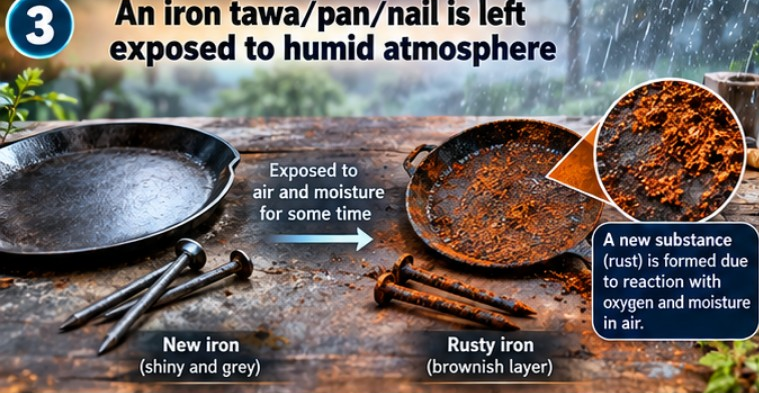
Now, this picture shows a new iron pan and a rusty iron pan.
When iron remains in contact with air and moisture for a long time, a brown layer gradually forms on its surface. This process is called rusting.
Iron reacts in the presence of oxygen and moisture to form rust, whose properties are different from those of iron. The formation of a new substance is an important indication of a chemical reaction. Therefore, rusting is also an example of a chemical reaction.
लोहे पर जंग लगना
अब इस चित्र में एक नया लोहे का पैन और एक जंग लगा हुआ लोहे का पैन दिखाई दे रहा है।
जब लोहा लंबे समय तक वायु और नमी (Moisture) के संपर्क में रहता है, तो उसकी सतह पर धीरे-धीरे भूरे रंग की परत बनने लगती है। इस प्रक्रिया को जंग लगना (Rusting) कहते हैं।
इस प्रक्रिया में लोहा, ऑक्सीजन और नमी की उपस्थिति में अभिक्रिया करके जंग बनाता है। जंग के गुण मूल लोहे से अलग होते हैं। किसी नए पदार्थ का बनना रासायनिक अभिक्रिया का एक महत्वपूर्ण संकेत है। इसलिए जंग लगना भी रासायनिक अभिक्रिया का उदाहरण है।
More Chemical Reactions in Daily Life
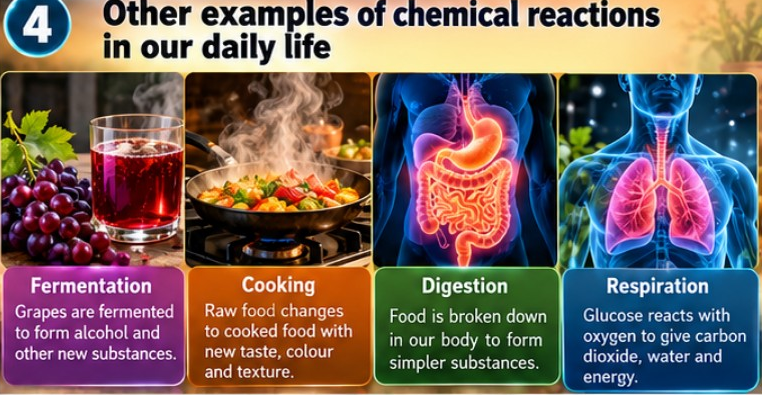
Let us understand a few more examples of chemical reactions from everyday life. The first is fermentation, in which microorganisms convert certain substances, such as sugars, into other substances. For example, fermentation takes place when grapes are used to make wine.
The second example is cooking. When we cook food, heat causes many chemical changes. The colour, taste, and texture of food change.
The third example is digestion. In our body, enzymes help break complex food molecules into simpler substances.
The fourth example is respiration. In this process, glucose is broken down inside cells and energy is released. Glucose reacts with oxygen to form carbon dioxide and water, releasing energy.
Thus, chemical reactions are an essential part of our food, our bodies, and everyday life.
दैनिक जीवन में रासायनिक अभिक्रियाओं के अन्य उदाहरण
आइए, दैनिक जीवन में होने वाली रासायनिक अभिक्रियाओं के कुछ और उदाहरण समझते हैं। पहला उदाहरण किण्वन (Fermentation) है। इसमें सूक्ष्मजीव शर्करा जैसे कुछ पदार्थों को दूसरे पदार्थों में बदल देते हैं। उदाहरण के लिए, अंगूर से वाइन बनाने की प्रक्रिया में किण्वन होता है।
दूसरा उदाहरण भोजन पकाना (Cooking) है। जब हम भोजन पकाते हैं, तो ऊष्मा के कारण अनेक रासायनिक परिवर्तन होते हैं। भोजन के रंग, स्वाद और बनावट में बदलाव आता है।
तीसरा उदाहरण पाचन (Digestion) है। हमारे शरीर में एंजाइम (Enzymes) जटिल खाद्य अणुओं को तोड़कर सरल पदार्थों में बदलने में सहायता करते हैं।
चौथा उदाहरण श्वसन (Respiration) है। इस प्रक्रिया में कोशिकाओं के अंदर ग्लूकोज़ का विघटन होता है और ऊर्जा मुक्त होती है। ग्लूकोज़, ऑक्सीजन के साथ अभिक्रिया करके कार्बन डाइऑक्साइड और जल बनाता है तथा ऊर्जा मुक्त करता है।
इस प्रकार रासायनिक अभिक्रियाएँ हमारे भोजन, शरीर और दैनिक जीवन का महत्वपूर्ण हिस्सा हैं।
What Is a Chemical Reaction?
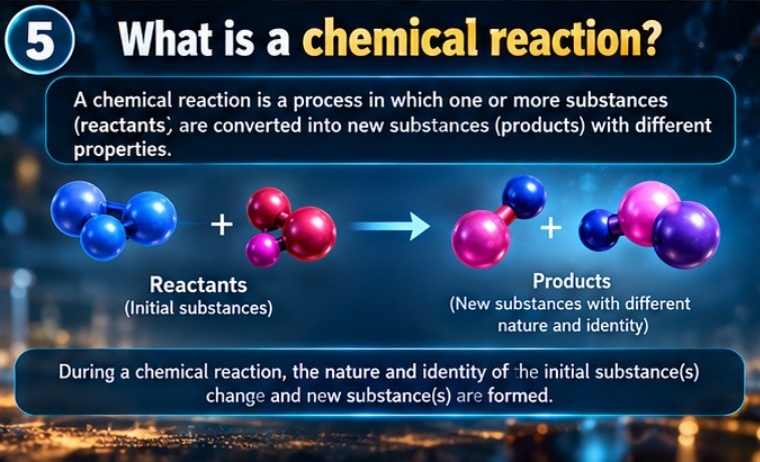
Now the question is: what exactly is a chemical reaction? A chemical reaction is a process in which one or more substances change to form new substances with properties different from those of the original substances.
Two important terms used in a chemical reaction are reactants and products. Reactants are the substances present at the beginning of a reaction that take part in it. Products are the new substances formed as a result of the reaction.
In the illustration, molecules of the reactants are changing into molecules of the products. In an actual chemical reaction, atoms are rearranged; they are not created or destroyed in an ordinary chemical change. Remember: reactants are present at the beginning, while products are formed after the reaction.
रासायनिक अभिक्रिया क्या है?
अब सवाल है कि रासायनिक अभिक्रिया किसे कहते हैं? रासायनिक अभिक्रिया (Chemical Reaction) वह प्रक्रिया है जिसमें एक या अधिक पदार्थ बदलकर नए पदार्थ बनाते हैं, जिनके गुण पहले वाले पदार्थों से अलग होते हैं।
रासायनिक अभिक्रिया में दो महत्वपूर्ण शब्द हैं—अभिकारक (Reactants) और उत्पाद (Products)। अभिकारक वे पदार्थ हैं जो अभिक्रिया की शुरुआत में मौजूद होते हैं और उसमें भाग लेते हैं। उत्पाद वे नए पदार्थ हैं जो अभिक्रिया के परिणामस्वरूप बनते हैं।
चित्र में आप देख सकते हैं कि अभिकारकों के अणुओं से उत्पादों के अणु बन रहे हैं। वास्तविक रासायनिक अभिक्रियाओं में परमाणुओं का पुनर्विन्यास (Rearrangement) होता है। सामान्य रासायनिक परिवर्तन में परमाणु न तो उत्पन्न होते हैं और न ही नष्ट होते हैं। याद रखिए—अभिकारक शुरुआत में मौजूद होते हैं और उत्पाद अभिक्रिया के बाद बनते हैं।
NCERT Activity 1.1 — Burning of Magnesium Ribbon
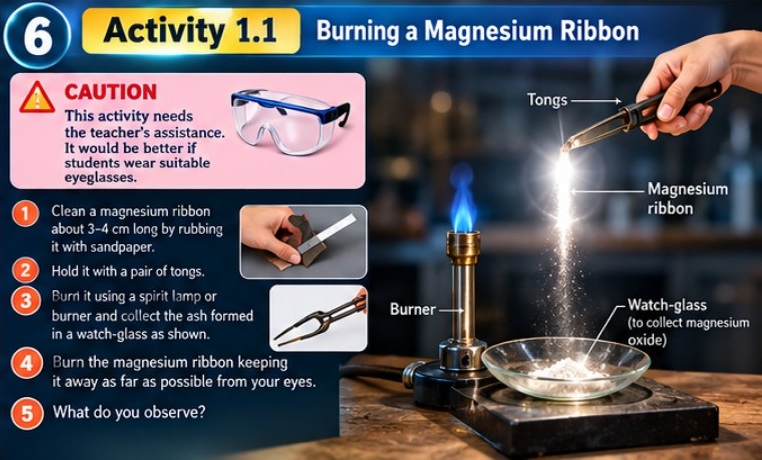
Let us now understand NCERT Activity 1.1. First, a magnesium ribbon is cleaned with sandpaper to remove the layer of magnesium oxide present on its surface.
Next, the ribbon is held with a pair of tongs and brought into the flame of a burner. Magnesium burns with a dazzling white light and, at the end, forms a white powder. This white powder is magnesium oxide.
In words, the reaction can be described as: magnesium reacts with oxygen to form magnesium oxide. Two magnesium atoms react with one molecule of oxygen to form two formula units of magnesium oxide.
A new substance is formed in this activity, and heat and light are released. Therefore, it is a clear example of a chemical reaction. For safety, this experiment should be performed under a teacher’s supervision. Do not look directly at burning magnesium.
NCERT गतिविधि 1.1 — मैग्नीशियम रिबन का जलना
अब हम NCERT की गतिविधि 1.1 को समझते हैं। सबसे पहले मैग्नीशियम रिबन को सैंडपेपर से साफ किया जाता है, ताकि उसकी सतह पर मौजूद मैग्नीशियम ऑक्साइड की परत हट जाए।
इसके बाद इसे चिमटे (Tongs) की सहायता से पकड़कर बर्नर की लौ में जलाया जाता है। मैग्नीशियम तेज़, चमकदार सफेद प्रकाश के साथ जलता है और अंत में सफेद चूर्ण बनता है। यह सफेद चूर्ण मैग्नीशियम ऑक्साइड है।
इस अभिक्रिया को शब्दों में इस प्रकार समझ सकते हैं—मैग्नीशियम, ऑक्सीजन के साथ अभिक्रिया करके मैग्नीशियम ऑक्साइड बनाता है। मैग्नीशियम के दो परमाणु, ऑक्सीजन के एक अणु के साथ अभिक्रिया करके मैग्नीशियम ऑक्साइड की दो इकाइयाँ बनाते हैं।
इस गतिविधि में नया पदार्थ बनता है और ऊष्मा तथा प्रकाश मुक्त होते हैं। इसलिए यह रासायनिक अभिक्रिया का स्पष्ट उदाहरण है। सुरक्षा के लिए यह प्रयोग शिक्षक की देखरेख में करना चाहिए और जलते हुए मैग्नीशियम को सीधे नहीं देखना चाहिए।
NCERT Activity 1.2 — Formation of a Yellow Precipitate
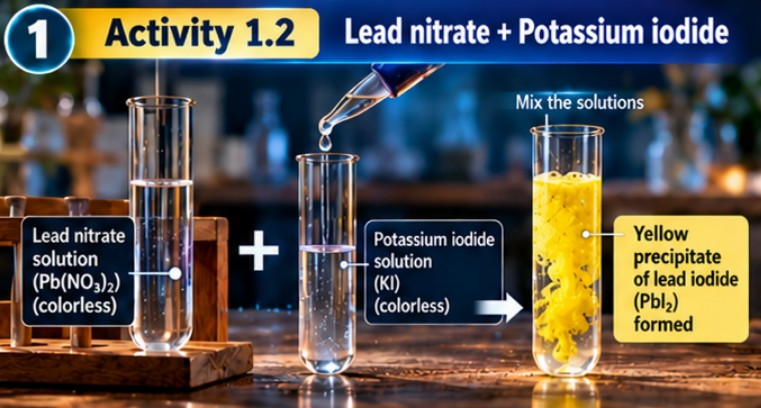
Let us begin Activity 1.2. We have two colourless solutions: the first is lead nitrate solution and the second is potassium iodide solution.
When the two solutions are mixed, a yellow solid is formed. This solid is called a precipitate. The precipitate formed here is lead iodide.
In words, lead nitrate reacts with potassium iodide to form lead iodide and potassium nitrate. Lead iodide appears as a yellow precipitate, while potassium nitrate remains dissolved in the solution.
Both solutions were colourless at the beginning, but a yellow solid appeared after mixing. The colour change and precipitate formation are evidence that a chemical reaction has occurred.
NCERT गतिविधि 1.2 — पीले अवक्षेप का बनना
अब हम गतिविधि 1.2 शुरू करते हैं। यहाँ हमारे पास दो रंगहीन विलयन हैं। पहला लेड नाइट्रेट (Lead Nitrate) का विलयन है और दूसरा पोटैशियम आयोडाइड (Potassium Iodide) का विलयन है।
जब हम दोनों विलयनों को मिलाते हैं, तो एक पीला ठोस पदार्थ बनता है। इसे अवक्षेप (Precipitate) कहते हैं। यहाँ बनने वाला अवक्षेप लेड आयोडाइड (Lead Iodide) है।
इस अभिक्रिया को शब्दों में इस प्रकार पढ़ेंगे—लेड नाइट्रेट, पोटैशियम आयोडाइड के साथ अभिक्रिया करके लेड आयोडाइड और पोटैशियम नाइट्रेट बनाता है। लेड आयोडाइड पीले अवक्षेप के रूप में बनता है, जबकि पोटैशियम नाइट्रेट विलयन में घुला रहता है।
शुरुआत में दोनों विलयन रंगहीन थे, लेकिन मिलाने के बाद पीला ठोस दिखाई देने लगा। रंग में बदलाव और अवक्षेप का बनना इस बात के प्रमाण हैं कि रासायनिक अभिक्रिया हुई है।
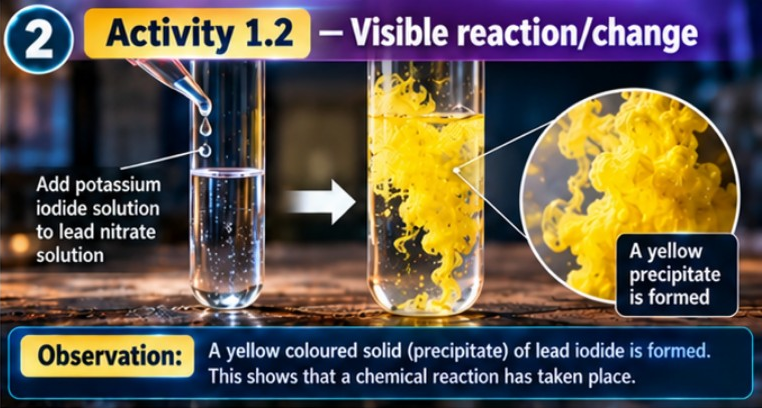
Precipitation Reaction
This panel shows the visible change in the same reaction more clearly. As potassium iodide solution is added to lead nitrate solution, a yellow lead iodide precipitate is formed.
A precipitate is an insoluble solid that forms and separates out when solutions react. Our observation is the formation of a yellow-coloured solid. This is not merely a change in colour; it is also evidence that a new substance has formed.
That is why this reaction is called a precipitation reaction. Remember, the formation of a precipitate is an important observable indication of a chemical reaction.
अवक्षेपण अभिक्रिया (Precipitation Reaction)
इस चित्र में हम उसी अभिक्रिया के दिखाई देने वाले परिवर्तन को अधिक स्पष्ट रूप से देख सकते हैं। जैसे ही पोटैशियम आयोडाइड का विलयन, लेड नाइट्रेट के विलयन में मिलाया जाता है, पीले रंग का लेड आयोडाइड अवक्षेप बनता है।
अवक्षेप (Precipitate) ऐसा अघुलनशील ठोस पदार्थ है, जो विलयनों की अभिक्रिया के दौरान बनकर उनसे अलग दिखाई देता है। हमारा अवलोकन है कि एक पीले रंग का ठोस पदार्थ बनता है। यह केवल रंग में बदलाव नहीं है, बल्कि नए पदार्थ के बनने का प्रमाण भी है।
इसीलिए इस अभिक्रिया को अवक्षेपण अभिक्रिया (Precipitation Reaction) कहा जाता है। ध्यान रखिए, अवक्षेप का बनना रासायनिक अभिक्रिया को पहचानने का एक महत्वपूर्ण प्रत्यक्ष संकेत है।
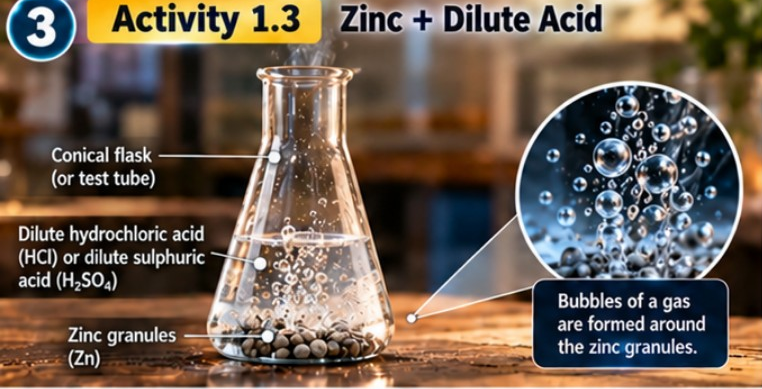
NCERT Activity 1.3 — Evolution of Hydrogen Gas
Now let us move to Activity 1.3. Zinc granules are placed in a conical flask. Dilute hydrochloric acid is then added to the flask.
As soon as the acid comes into contact with zinc, gas bubbles begin to appear around the zinc granules. These bubbles are hydrogen gas.
In words, zinc reacts with hydrochloric acid to form zinc chloride and hydrogen gas.
The formation of gas bubbles is evidence that a chemical reaction is taking place. This activity shows that the evolution of gas is an important indication of a chemical reaction.
NCERT गतिविधि 1.3 — हाइड्रोजन गैस का निकलना
अब हम गतिविधि 1.3 की ओर बढ़ते हैं। इस प्रयोग में एक शंक्वाकार फ्लास्क (Conical Flask) में जिंक के दाने (Zinc Granules) लिए जाते हैं। इसके बाद इसमें तनु हाइड्रोक्लोरिक अम्ल (Dilute Hydrochloric Acid) मिलाया जाता है।
जैसे ही अम्ल, जिंक के संपर्क में आता है, जिंक के दानों के आसपास गैस के बुलबुले बनने लगते हैं। ये बुलबुले हाइड्रोजन गैस के होते हैं।
इस अभिक्रिया को शब्दों में इस प्रकार पढ़ेंगे—जिंक, हाइड्रोक्लोरिक अम्ल के साथ अभिक्रिया करके जिंक क्लोराइड और हाइड्रोजन गैस बनाता है।
गैस के बुलबुले बनना इस बात का प्रमाण है कि रासायनिक अभिक्रिया हो रही है। इस गतिविधि से हम समझते हैं कि गैस का निकलना (Evolution of Gas) रासायनिक अभिक्रिया का एक महत्वपूर्ण संकेत है।
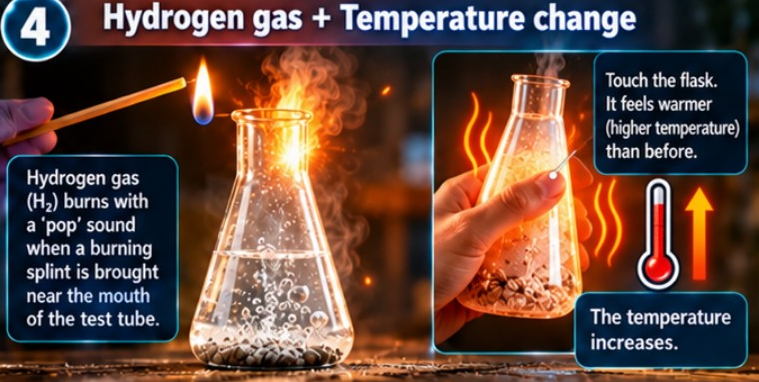
Temperature Change and Exothermic Reactions
In the previous experiment, we saw that hydrogen gas is formed when zinc reacts with dilute hydrochloric acid. Now let us focus on the change in temperature.
Under ordinary laboratory conditions, this reaction releases heat. Therefore, the temperature of the flask may rise and the flask may feel warmer than before. A reaction that releases heat is called an exothermic reaction. Hence, the reaction between zinc and dilute hydrochloric acid is an example of an exothermic reaction.
To identify hydrogen gas, a burning-splint test may be performed in a laboratory under a teacher’s supervision. Hydrogen may produce a characteristic pop sound when it burns. When hydrogen reacts with oxygen, water is formed and heat is released.
Remember that hydrogen is highly flammable. This test must only be carried out with proper laboratory safety precautions. This panel teaches us two important observations: gas evolution and temperature change can be observable signs of a chemical reaction.
तापमान में बदलाव और ऊष्माक्षेपी अभिक्रिया
पिछले प्रयोग में हमने देखा कि जिंक और तनु हाइड्रोक्लोरिक अम्ल की अभिक्रिया में हाइड्रोजन गैस बनती है। अब हम तापमान में होने वाले बदलाव पर ध्यान देते हैं।
सामान्य प्रयोगशाला परिस्थितियों में इस अभिक्रिया के दौरान ऊष्मा मुक्त होती है। इसलिए फ्लास्क का तापमान बढ़ सकता है और वह पहले की तुलना में गर्म महसूस हो सकता है। जिस अभिक्रिया में ऊष्मा मुक्त होती है, उसे ऊष्माक्षेपी अभिक्रिया (Exothermic Reaction) कहते हैं। इसलिए जिंक और तनु हाइड्रोक्लोरिक अम्ल की अभिक्रिया ऊष्माक्षेपी अभिक्रिया का उदाहरण है।
हाइड्रोजन गैस की पहचान के लिए प्रयोगशाला में शिक्षक की देखरेख में जलती हुई तीली की जाँच (Burning Splint Test) की जा सकती है। हाइड्रोजन जलने पर एक विशिष्ट 'पॉप' ध्वनि उत्पन्न कर सकती है। जब हाइड्रोजन, ऑक्सीजन के साथ अभिक्रिया करती है, तो जल बनता है और ऊष्मा मुक्त होती है।
याद रखिए, हाइड्रोजन अत्यधिक ज्वलनशील गैस है। इसलिए यह परीक्षण केवल उचित प्रयोगशाला सुरक्षा सावधानियों के साथ ही करना चाहिए। इस चित्र से हमें दो महत्वपूर्ण बातें सीखने को मिलती हैं—गैस का निकलना और तापमान में बदलाव रासायनिक अभिक्रिया के दिखाई देने वाले संकेत हो सकते हैं।
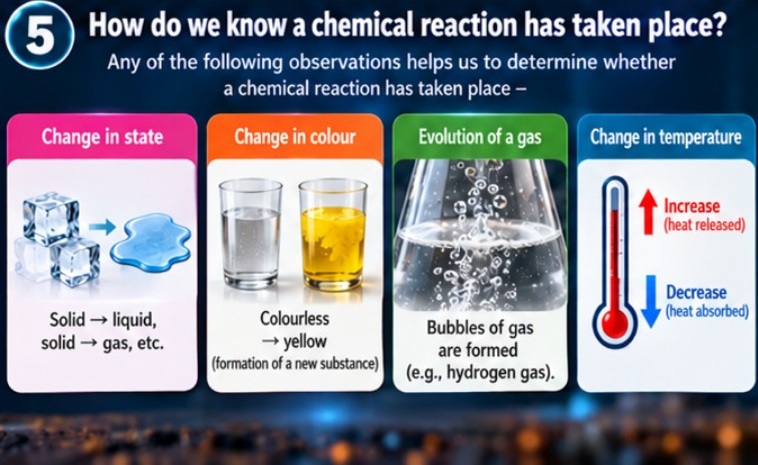
How Can We Identify a Chemical Reaction?
So far, we have observed several chemical reactions. But what observations should we look for to identify a reaction?
One indication is a change in state. During a reaction, a change involving solid, liquid, or gaseous states may be observed. However, a physical change of state by itself is not proof of a chemical reaction.
Another indication is a change in colour. For example, when lead nitrate and potassium iodide solutions are mixed, a yellow precipitate forms. A third indication is the evolution of gas, as seen when zinc reacts with dilute hydrochloric acid and hydrogen bubbles appear.
A fourth indication is a change in temperature. Some reactions release heat, while others absorb heat. Reactions that release heat are called exothermic reactions, whereas reactions that absorb heat are called endothermic reactions.
Remember, all these changes do not have to occur together in every chemical reaction. Other evidence must also be considered.
रासायनिक अभिक्रिया की पहचान कैसे करें?
अब तक हमने कई रासायनिक अभिक्रियाएँ देखीं। लेकिन किसी अभिक्रिया को पहचानने के लिए किन अवलोकनों पर ध्यान देना चाहिए?
पहला संकेत है अवस्था में परिवर्तन (Change in State)। अभिक्रिया के दौरान ठोस, द्रव या गैस जैसी अवस्थाओं में बदलाव दिखाई दे सकता है। हालाँकि, केवल भौतिक अवस्था बदलना अपने आप में रासायनिक अभिक्रिया का प्रमाण नहीं है।
दूसरा संकेत है रंग में परिवर्तन (Change in Colour)। उदाहरण के लिए, लेड नाइट्रेट और पोटैशियम आयोडाइड के विलयनों को मिलाने पर पीला अवक्षेप बनता है। तीसरा संकेत है गैस का निकलना (Evolution of Gas), जैसा कि जिंक और तनु हाइड्रोक्लोरिक अम्ल की अभिक्रिया में हाइड्रोजन के बुलबुले बनने पर दिखाई देता है।
चौथा संकेत है तापमान में परिवर्तन (Change in Temperature)। कुछ अभिक्रियाओं में ऊष्मा मुक्त होती है, जबकि कुछ में ऊष्मा अवशोषित होती है। ऊष्मा मुक्त करने वाली अभिक्रियाएँ ऊष्माक्षेपी (Exothermic) और ऊष्मा अवशोषित करने वाली अभिक्रियाएँ ऊष्माशोषी (Endothermic) कहलाती हैं।
याद रखिए, हर रासायनिक अभिक्रिया में ये सभी परिवर्तन एक साथ होना आवश्यक नहीं है। अन्य प्रमाणों को भी ध्यान में रखना चाहिए।
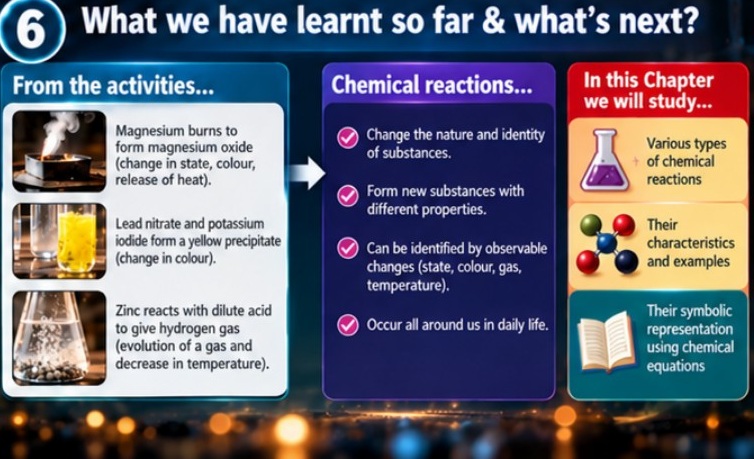
Chapter Introduction — Quick Recap
So, students, today we have learned several important ideas about chemical reactions. When magnesium burns, magnesium oxide is formed and heat and light are released. When lead nitrate reacts with potassium iodide, a yellow lead iodide precipitate is formed. When zinc reacts with dilute hydrochloric acid, hydrogen gas is evolved and heat may be released.
We have also learned that new substances are formed in chemical reactions. To identify them, observations such as a change in colour, evolution of gas, formation of a precipitate, and change in temperature are useful.
But we still need to learn another important way of writing and understanding chemical reactions: chemical equations. In the next part, we will learn how chemical equations are written, why they must be balanced, and how chemical reactions are classified.
We will then study combination, decomposition, displacement, and double displacement reactions.
अध्याय का परिचय — संक्षिप्त पुनरावृत्ति
तो विद्यार्थियों, आज हमने रासायनिक अभिक्रियाओं के बारे में कई महत्वपूर्ण बातें सीखीं। मैग्नीशियम के जलने पर मैग्नीशियम ऑक्साइड बनता है और ऊष्मा तथा प्रकाश मुक्त होते हैं। लेड नाइट्रेट और पोटैशियम आयोडाइड की अभिक्रिया में पीले रंग का लेड आयोडाइड अवक्षेप बनता है। जिंक और तनु हाइड्रोक्लोरिक अम्ल की अभिक्रिया में हाइड्रोजन गैस निकलती है और ऊष्मा मुक्त हो सकती है।
हमने यह भी सीखा कि रासायनिक अभिक्रियाओं में नए पदार्थ बनते हैं। इन्हें पहचानने के लिए रंग में बदलाव, गैस का निकलना, अवक्षेप का बनना और तापमान में बदलाव जैसे अवलोकन उपयोगी होते हैं।
लेकिन अभी हमें रासायनिक अभिक्रियाओं को लिखने और समझने का एक और महत्वपूर्ण तरीका सीखना है—रासायनिक समीकरण (Chemical Equations)। अगले भाग में हम सीखेंगे कि रासायनिक समीकरण कैसे लिखे जाते हैं, उन्हें संतुलित करना क्यों आवश्यक है और रासायनिक अभिक्रियाओं का वर्गीकरण कैसे किया जाता है।
इसके बाद हम संयोजन (Combination), अपघटन (Decomposition), विस्थापन (Displacement) और द्विविस्थापन (Double Displacement) अभिक्रियाओं का अध्ययन करेंगे।